
||Why Bhārata instead of India||
There is a 2200 years old “Hātigumphā Inscription” found in the ‘Udayagiri Hills’, near Bhubaneshwar in Odisha. This is a very special inscription, as it contains the earliest recorded mention of the word “Bhāratavarṣa” (Prakritized as – ‘Bhāratavasa’). Line number 10 of this inscription mentions “Bharatavarsha” (translation published by Jayaswal and Banerji in Epigraphia Indica -Volume 20 (is in public domain).
The inscription was commissioned by “Mahārāja Kharavela Mahameghavāhana” of Kalinga. and refers to his expeditions throughout “Bhāratvarsha” that is India. The Inscription is dated to 13th year of Kharavela’s reign in 2nd c. BCE, thus giving us indisputable evidence that our country was known as Bhārat 2200 years ago.

The “Viṣṇu Purāṇa” also reads as follows:
उत्तरं यत्समुद्रस्य हिमाद्रेश्चैव दक्षिणम् । वर्षं तद् भारतं नाम भारती यत्र संततिः ।।
(Vishnu Purana – II, 3.1)
Translated it means: “The Country that lies north of the ocean and south of the Himālaya is called Bhārata, there dwell the descendants of Bharata (Bharata Santati).”


|| The word Bharata as given in the Rig Veda ||
The word “Bharata” can be traced back much earlier to the Rig Veda, when compared to the Greek historian Herodotus of 5th century BCE, who first mentioned “Indía,” from a Greek perspective, as a derivative of “Indós”, the Sindhu river (for Persian equivalent of which is “Hindu”).
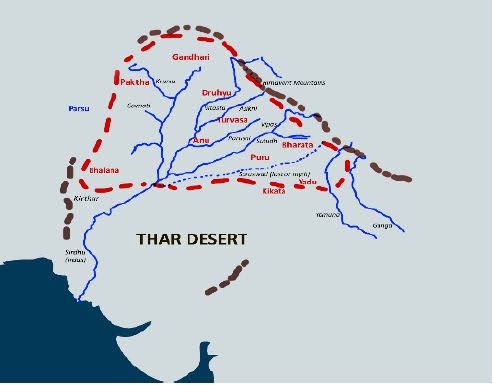

Images: The Dashrajana war between Bharata tribes and a coalition of 10 other kings took place in phases, and the last phase was fought by the side of the Parusni river, which according to Yaska (nirukta 9.26) refers to the Iravati or Ravi river, which is now located in West Punjab, Pakistan.
In the 18th hymn of the Rig Veda Samhita, Mandala 7 also known as Vasishtha Mandala book, there is detailed recount of the “Dasharajna” or the battle of ten kings. The conflict was between the Bharata tribe led by King Sudas and a coalition of 10 other tribes (both Vedic and non Vedic – eg. Alinas, Bhrigus, Dasas, Druhyus, etc.). Raja Sudas Paijavana and his army (Bharatavamsha) of the Bharata tribe won the war.


Rig Veda, which was compiled around 1500 BCE, holds in its verses knowledge much older than 1500 BCE. Infact, Rig Veda has verses that speak in symbolisms of the end of the ice age period (some 10000 plus years back).
This Bharata tribe is from the Rig Veda and is the earliest reference to the term Bharata. Rest are later period Puranic stories. One such story tells that Queen Merudevi and King Naabhi had a son named Rishabha, who was a part-incarnation of Sri Vishnu. King Rishabha and Queen Jayanti’s son was Bharata, after whom our country Bharata is named. This is mentioned in Bhagavata Purana 5.3.16–5.4.9, 5.7.3.
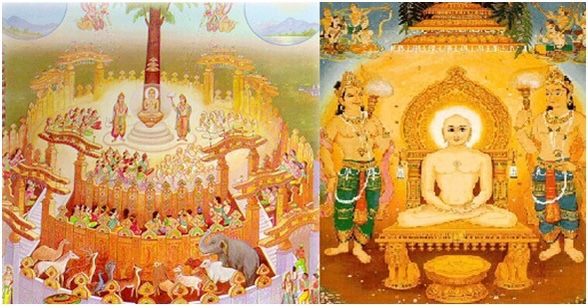
The other version of this story tells us Marudevi Mata & Nabhi Raja are parents of Rrishabhadev the 1st Tirthankar of Jains, who is also known as Adinath. His eldest son is Chakravarty samrat Bharat.
Another story from ‘Adi Parva’ in Mahabharata tells that king Bharata was the son of Queen Shakuntala and King Dushyanta, and it was after him that this land was named Bharatavarsha.

Again there is another story of Bharata (a son of Queen Sunanda and Jain tirthankara Rishabhadeva) who fought against his brother Bahubali.
|| How did the Bharata clan of RigVeda get that specific name Bharata ||
The Bharata clan/ tribe got their name from Agni, whose other name is bhaarata/bhArata; hence signifying the ancient Vedic Bharata clan were a community of fire worshippers.
tvaṃ no asi bhāratāgne vaśābhir ukṣabhiḥ aṣṭāpadībhir āhutaḥ ||
~ RV 2.7.1
(Translation: Agni, descendant of Bharata, you are ours…..)
The priests of a yajna who light the fire are also known as bharatas. As they start Agni, the latter is symbolically referred to as their child. As per Sanskrit grammar, a child can be named by prolonging one or more vowels in the parent’s name (guNavRddhi). Based on that Agni is the symbolical son of the priests, bharatas (भरताः), and so he is called bhArata (भारतः) in the above given hymn.

Bharata comes from the root ‘bhṛ’, which means: to support or maintain. It also refers to Agni /bhArata’ ; so automatically when the clan named itself as Bharata, it meant they were supporters or carriers of the fire or Agni; which in simple terms meant – fire worshippers or Agni upashak.

Thus, behind the name Bharata/Bharat lies the identity of the ancient homa or fire sacrificial culture, known as the Agnihotra culture. The Bharata clan were Agni worshippers and performed constant homas or agnihotras, with their initial area of control being the Saptasindhu region.
 Moni Gāthā